
Talking to Teachers and Schools About a 2e Kid, at Every Age
Advocating for a 2e kid looks different at every stage, and the difference isn’t subtle.
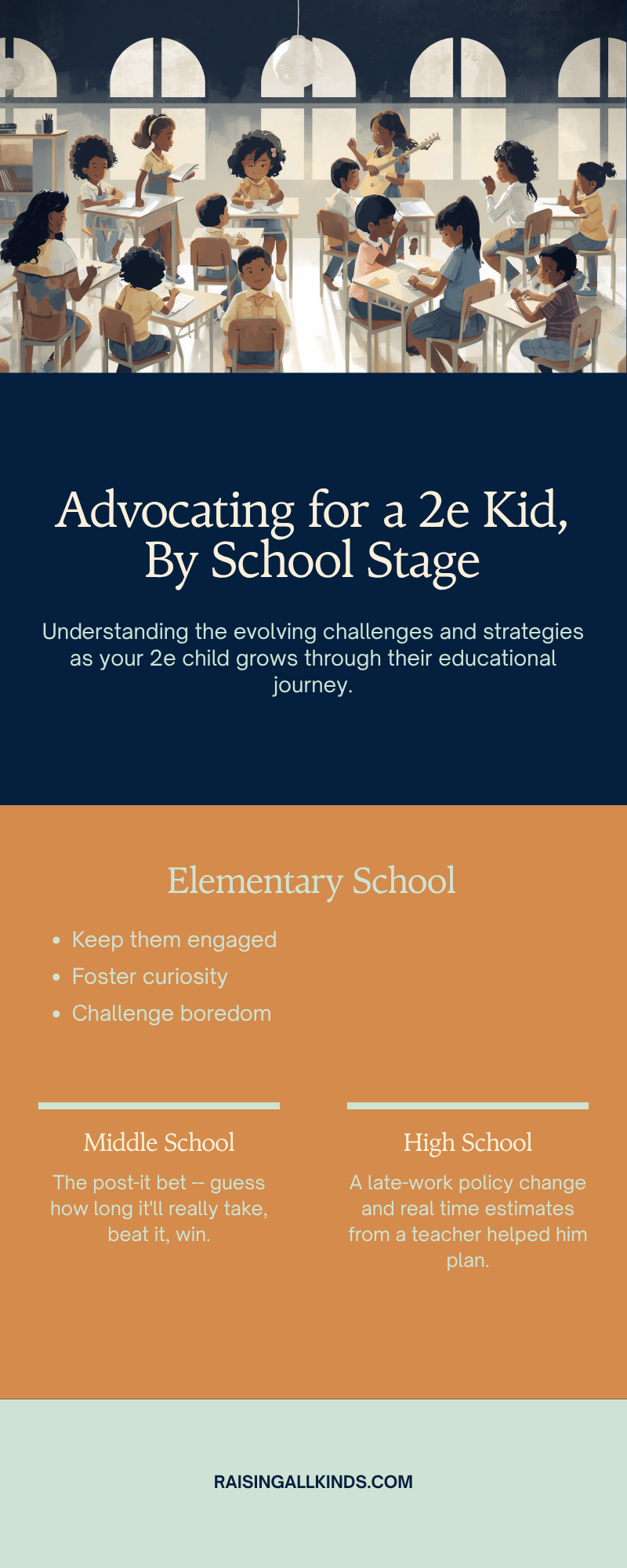
In elementary school, the primary challenge for me was keeping him from being bored and starting to hate school – the struggle was mostly about the gifted side going unfed. As kids get older, school shifts to rewarding conformity: sticking to a standard schedule, homework on time, tests on a fixed calendar. The more that conformity gets demanded, the more visible the differences in a 2e kid become.
The best example I have of a school actually working well came when my oldest was 16, going through a genuinely hard year emotionally. He was hiding a lot of his grades from me, and eventually his therapist wrote a letter to the school. It was a perfect storm – 2e struggles layered on top of everything else going on. The school mobilized well. They changed their homework late policy so he could submit as many late assignments for full credit as he could complete, which kept him from failing the semester. One teacher in particular helped in a smaller but useful way. She started emailing me how long she expected that week’s homework to take, because what I was hearing from him was always “it’ll take forever,” or a flat “at least 10 hours.” Having her real estimate let me help him manage his time instead of arguing over a number neither of us trusted.
That same overwhelm (everything taking “forever” in his head) showed up earlier too, in middle school. What worked was going through each assignment with him and writing down, on a post-it, how long I thought it would realistically take. If it took less than that estimate, which it almost always did, he won the bet. The prize varied: choosing dinner, a small treat, playing something together. It sounds almost too simple, but turning “this will take forever” into something measurable and winnable broke the spiral in a way that just telling him to get started never did.
As my kids have gotten older, my role in these conversations has changed too. My younger two are both in nontraditional school setups now, and I’ve stepped back accordingly. My middle kid is a strong self-advocate who doesn’t need much from me. My oldest, even now, struggles with the idea that “all they can say is no.” He takes being turned down personally, more than most. I stayed heavily involved with him all the way through graduation, and I don’t think that was wrong; it was what he needed.
I don’t have a clean story about a school conversation that went badly. The honest answer is that I’m still gathering that material from other parents, because everyone’s worst story looks different. What I can say is that the conversations that worked shared one thing: someone at the school treating the problem as solvable together, instead of as a rule that couldn’t bend.
If you’re earlier in this process, here are the signs that started this for us, and what nobody really tells you once you have the label covers how the parenting job itself keeps shifting.
Names and identifying details in this post have been changed to protect my kids’ privacy. “Annie Hart” is a pen name for the same reason.