
Signs Your Child Might Be Twice-Exceptional

I didn’t know the word “twice-exceptional” existed until fairly recently – not until my oldest was almost through high school. If you’re reading this and you’ve never heard it either, you’re not behind. A lot of parents live this for years before anyone hands them the vocabulary for it.
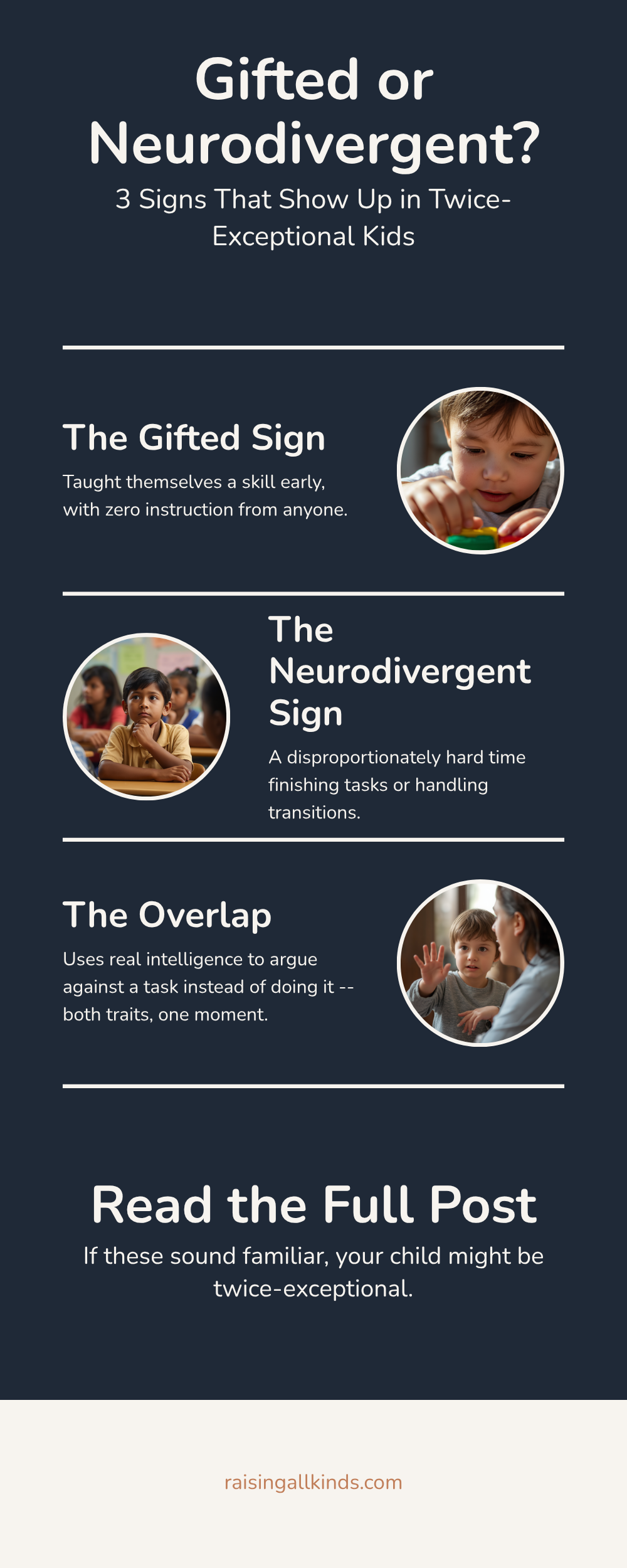
The quick version, if you’re short on time: a skill that shows up early and out of nowhere, self-taught, with no instruction from anyone – right alongside something disproportionately hard, like finishing work, reading a room, sitting through a transition, or connecting with peers. An interest that goes past “really into it” into genuinely intense, doesn’t-fade-with-age territory. Social friction that doesn’t look like shyness, more like trouble with flexibility or a slow drift away from friendships that used to be easy. None of it requires a diagnosis to be real, whether what’s underneath turns out to be gifted-and-ADHD, gifted-and-autistic, or something else entirely. Keep reading for what this actually looked like in my house.
Twice-exceptional, or 2e, just means a kid who’s significantly ahead of average in one area and also dealing with something like autism or ADHD in another. The two sides can hide each other, they can compound one another, and they can also create unique responses, challenges, and successes. A kid who’s bright enough to develop coping mechanisms can also bandaid over their struggles, and seem to handle school, and friends, and life just fine. For me, this is exactly what happened… only the bandaids didn’t work well as he got into middle and high school.
Here’s what it looked like in my house.
I always knew he was smart. My son taught himself to read. Not “was ahead of his class”: taught himself, on his own, sometime around age two, before speech therapy had even resolved his delayed talking. When he did suddenly start speaking right before he turned 3, he went from non-verbal to complete sentences in one day. And he could read. What I realized in hindsight was that he memorized the books we read out loud, and then went back and matched the words he remembered me reading to what the text in the book was. By the time he started preschool, I had to sit down with his teacher and warn her: he already knows how to read, please plan for that, because he is going to be bored otherwise.
I only really understood how unusual the reading thing was once my daughter came along and struggled to read. The complete opposite experience (“I will NEVER be able to learn to read, Mom!” she yelled at age 6). That contrast is what told me the first one hadn’t been normal. As a first-time parent, I just didn’t have a baseline. I do now.
We also had a set of wooden puzzles he loved. At two and three, he used to turn them upside down. On purpose. To make them harder for himself. To this day, he buys himself 1000-piece puzzles and finishes them in less than a day.

I bring up both of those because they’re the kind of thing that gets filed under “smart kid, cute story.” And it is a cute story. But looking back, that same drive to figure things out himself, with the intelligence to make it happen, ran straight into an ADHD challenge. The gifted-and-ADHD combination that would come to define a lot of his adolescence. No matter how smart he was, he still, for example, had trouble finishing anything on a deadline without a huge amount of help from me. Instead, that amazing intelligence was used to argue why he had to write down his algebra equations when he could do it in his head; why he had to do the homework to prove he knew the material when he clearly did; why this class or that class was required to graduate from high school; why he should take out the trash when he did it yesterday; why he should clean his room when he knew where everything was… the list goes on.
That’s the part that’s easy to miss. The “gifted” side is usually the visible one. The struggling side hides behind it, because a kid who’s clearly bright doesn’t read as a kid who’s also drowning in one specific way. What I know now is that he struggled greatly to focus his attention on doing something he didn’t want to do. And then he would get distracted. And then he’d have to come back to the “thing.” And then the cycle would repeat. So an easy 15-minute task for me felt like an insurmountable mountain to him that would take “forever,” and so he was resistant to doing it. It took him and me years to get to the point where he was mature enough to articulate what he was struggling with, and I was armed with tools and systems to address the specific struggles to support him.
A pediatrician named it once, almost as an aside. My son was eight, mid-appointment, giving her the full rundown on some Transformer he was into. At the end, she told me he was “definitely on the spectrum, but quite high-functioning,” and that it was up to me whether I wanted to do anything about it. That was the first time anyone had put a name to the other side of it: gifted and autistic, not just gifted. I didn’t forget that sentence. But I also didn’t act on it. She didn’t seem worried, so I wasn’t either. It took years, and a lot of my own reading, before I understood that “high-functioning” mostly meant he was good at hiding it, not that there wasn’t anything there.
If you’re wondering whether this might be your kid, here’s the pattern I’d tell a friend to watch for, based on three kids who are all different from each other:
A skill that shows up early and out of nowhere, with no instruction. Not just “ahead of the curve,” but self-taught. Alongside it, something that’s disproportionately hard: finishing work, reading a room, sitting through a transition, connecting with peers. The two don’t cancel each other out. They coexist, and the strong side usually gets noticed first, which is exactly what delays anyone noticing the other one.
An interest that goes past “really into it” and into intense, doesn’t-fade-with-age territory.
Social friction that doesn’t look like shyness. More like trouble with flexibility, or difficulty letting go of a topic once he’s on it, or a slow drift away from friendships that used to be easy.
This is all real with or without a diagnosis, and I want to say that clearly, because I spent years not pursuing testing because I couldn’t see the point of it. No medication I wanted to use, no “fix” I was after. What I didn’t understand then is that identifying this was never about fixing anything. It’s about understanding what you’re looking at, so you’re not spending years wondering why your smart kid is struggling with things that “shouldn’t” be hard for him.
I think about how much of that he handled on his own up until high school (when life got hard enough that systems began to break down), quietly, because he was smart enough to manage it without telling anyone. I’ll never know the full answer to that. I do know I’d rather have had the language for this ten years earlier than I did.
If this sounds like your kid, here’s the fuller identification timeline, what nobody really tells you once you have the label, and how the conversation with teachers changes as your kid gets older.
Names and identifying details in this post have been changed to protect my kids’ privacy. “Annie Hart” is a pen name for the same reason.