
Routine Charts Fell Apart in My House. Yours Might Be Different.
I’ve tried routine charts more times than I can count, and they fell apart every single time. Theoretically, they’re great – a picture or a checkbox for each step, a clear visual of what comes next. In practice, keeping on top of one long enough for anything to actually become a habit turned out to take more mental load than the chart was supposed to save me.
Growing up, my own family had something that worked: a rotating chore list, and the rule was simple – everything on it had to be done by noon on Saturday, or no allowance. I loved that system, and looking back, I think I know why it held up when my own attempts at routine charts didn’t. It wasn’t just a list asking for compliance. There was a real consequence attached, on a real deadline, that mattered to a kid. A chart taped to the wall with cute icons doesn’t have that behind it. It’s just a request, and requests are easy for a kid to ignore once the novelty wears off.
I’d love to run something like that rotating chore list again, honestly. It’s just harder to implement now, with kids’ schedules being what they are. Sports, jobs, activities that don’t leave a clean, predictable Saturday morning the way my own childhood did.
If a routine chart is working in your house, that’s great, and I don’t think that means you’re doing something I couldn’t. I think it means either your kid responds differently than mine did, or there’s a real consequence built into your version that mine were missing.
If a routine chart might work in your house (and for plenty of kids, it does) here’s what tends to make the difference.
What makes a chart work
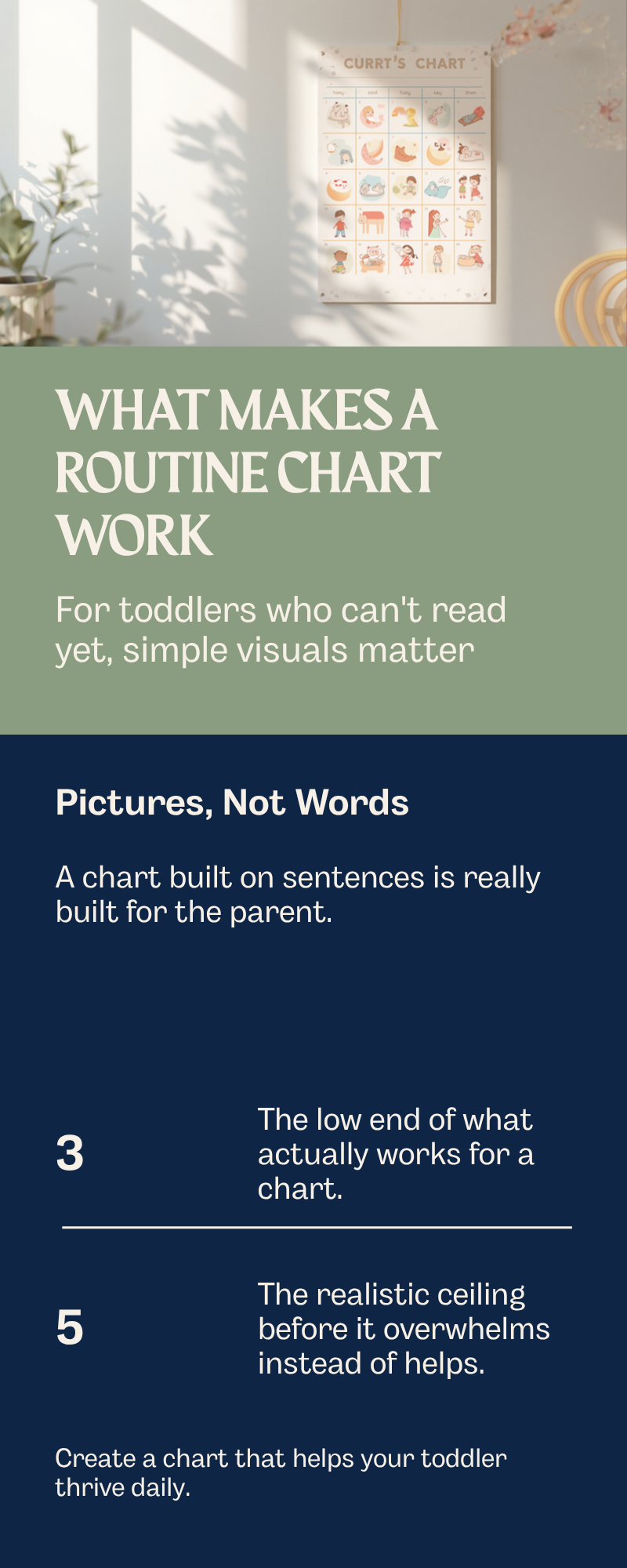
Pictures do the work, not words. A toddler can’t read yet, so a chart built around sentences is really a chart built for the parent, not the kid. Photos of your actual child doing the actual task tend to work better than generic clipart, because it removes a layer of translation a toddler’s brain doesn’t need to do. A physical “done” zone matters more than it sounds like it should: a Velcro strip, a pocket, or a spot where a kid physically moves a picture from “to do” to “done” gives the brain something concrete to grab onto. Real buy-in changes everything, even at a young age. A kid who helped choose the pictures, or helped decide the order steps go in, engages with the chart differently than one who’s just handed a finished product. Keep it short: three to five steps is the realistic ceiling before the chart itself becomes overwhelming instead of helpful.
A starting example
A four-step morning chart might be just: use the potty (or diaper change), get dressed, eat breakfast, brush teeth. A bedtime version might be: bath, pajamas, brush teeth, pick a book, into bed. Both are short enough to finish without losing a kid’s attention halfway through.
If it stops working, or never worked to begin with, that’s real information too. Not every kid responds to a visual chart. If that’s your kid, I wrote about what we do instead of a checklist system in my house, and the family command center covers the household-wide version of the same idea.
Names and identifying details in this post have been changed to protect my kids’ privacy. “Annie Hart” is a pen name for the same reason.