
Where to Start With Checklists, Age 2 Through Teen
I wrote recently about why checklists have never worked in my house. That’s true for us – but it’s not a universal law, it’s just my house. Plenty of kids do great with a checklist, and if yours is one of them, that’s just as valid a system as whatever ends up working for mine. Every kid is different, every family is different, and “worked for someone on the internet” matters a lot less than “worked for your actual kid.” With that in mind, here’s what’s generally recommended by age, with actual examples to start from.
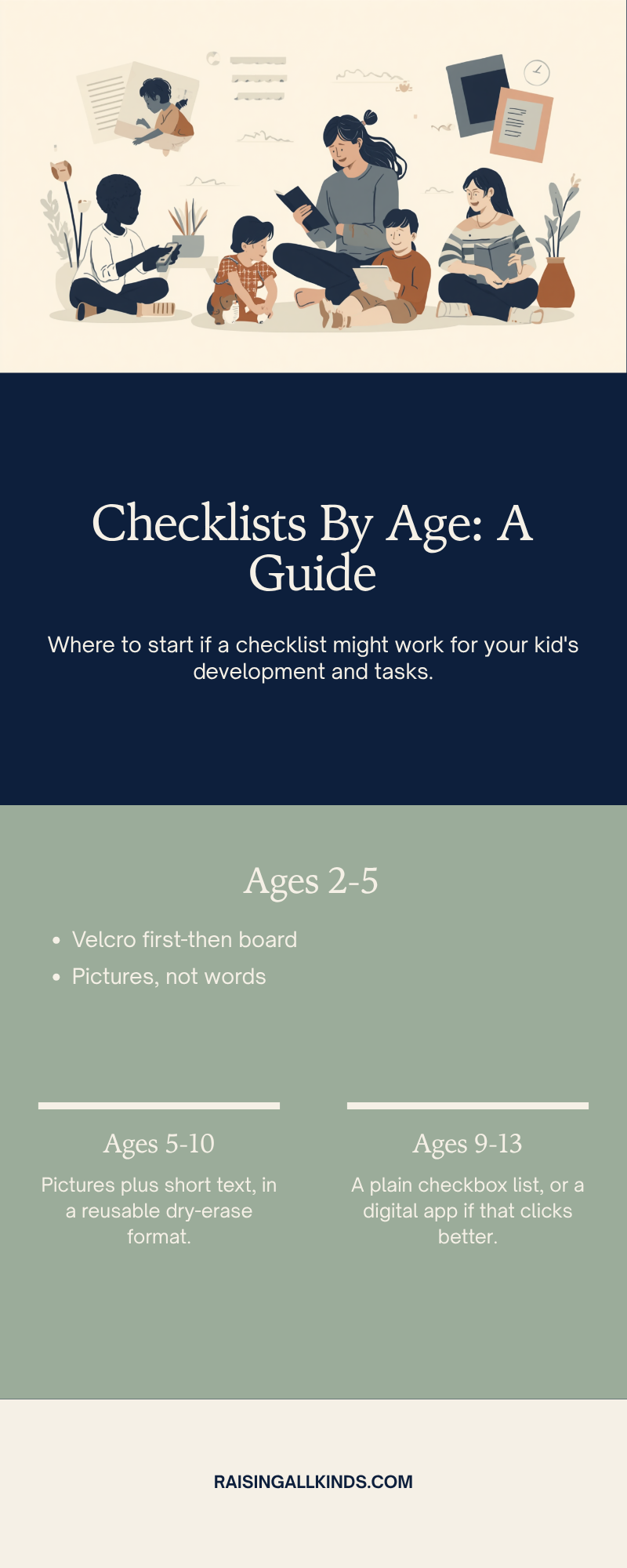
Toddlers and preschoolers (roughly ages 2 to 5)
Pictures, not words – a photo or simple icon for each step, not a sentence. Keep it to three to five steps; more than that tends to overwhelm a kid this age rather than help them. A “first-then” board, or a Velcro-based board where a kid physically moves a picture from “to do” to “done,” makes progress concrete for a brain that’s still building that concept.
A bedtime checklist at this age might look like: brush teeth, put dirty clothes in the laundry basket, put on pajamas, pick out a book, get into bed. A morning checklist might be just as short: use the potty, get dressed, eat breakfast, brush teeth, put on shoes. At this age, toddlers can also start helping with simple tasks like putting toys away or wiping down a table. Not because it needs to get done well, but because kids this age often find “helping” genuinely exciting, which is worth taking advantage of while it lasts.
Elementary age (roughly 5 to 10)
Pairing pictures with short text still matters more than people expect for kids who struggle with executive function, even once they’re reading well. A reusable, laminated or dry-erase format tends to outlast paper, if only because it survives daily use without needing to be reprinted.
A morning checklist here might expand to: get dressed, make bed, eat breakfast, brush teeth and hair, pack backpack (homework, lunch, any forms), put on shoes. An evening checklist might be: pack backpack for tomorrow, lay out clothes, bath or shower, brush teeth, reading time, lights out. This is also the age where kids can reliably take on chores like clearing their own dishes, sorting laundry, watering plants, or making their bed: a simple chore checklist (feed the pet, set the table, tidy your room) works the same way the routine ones do.
Tweens (roughly 9 to 13)
Some kids are ready to self-monitor with a plain checkbox list and don’t need pictures anymore; others still do, and that’s not a step backward. This is also the age where digital tools start to click for kids who are motivated by them. Less because the format is inherently better, and more because a phone or tablet doesn’t feel like a “little kid” tool, which matters more at this age than it probably should.
Chores can get meaningfully more independent here. Loading and unloading the dishwasher without help, doing their own laundry start to finish, or a simple homework checklist: check what’s due, gather materials, work through each subject, pack the bag when done. A self-care checklist can also start mattering more at this age as hygiene routines get more involved (shower, deodorant, brush teeth) without a parent standing over it.
Teens (13+)
By this age it’s less about the list format and more about whether the system is something they’ll actually open. A few apps built specifically around ADHD and executive function come up often in that research: Tiimo, a visual planner with icon-based schedules and countdown timers; Goblin.tools, which has a feature that breaks an overwhelming task like “clean my room” into a concrete checklist automatically; and TickTick, a more general to-do app with lists, a calendar view, and built-in timers. I haven’t personally used any of these with my own kids. I’m passing them along because they show up consistently in ADHD-specific recommendations, not because I’ve tested them myself. Most teens at this point can take on nearly any household task with minimal supervision, so the checklist question becomes less about what they’re capable of and more about what gets used. The one piece of advice that shows up everywhere is worth repeating: a mediocre system your kid uses beats a perfect one that gets abandoned in a week.
If none of this sticks, that’s fine too. See why checklists never worked in my house for exactly what that looked like, and what we do instead. Routine charts are a close cousin of the toddler checklist above, if you want a second format to try.
Names and identifying details in this post have been changed to protect my kids’ privacy. “Annie Hart” is a pen name for the same reason.